


The Problem
The buyer has begged you to send your proposal to them as fast as possible, hinting they can make the decision and walk you through all the sales hurdles in their company. They've got the power, they say. They're desperate, they say. This is a strategic priority, they add.
You spend your evenings and weekends with your team getting it ready. You miss time with your family and forget to eat, living in your pyjamas and newly acquired computer beard.
Then finally, you send the best proposal of your life. This is the Da Vinci of proposals. It has every ask catered for. It leads the client to fresh elixir, giving them every possible requirement - ensuring you are the right supplier. It shows boldness, differentiation and stronger capability than the other puny punks in the car park.
And then the fucker ghosts you.

New Growth Blockers
Some 12 years ago, I wrote an enterprise sales course for 300 top partners at a Fortune enterprise on how to win major deals. The answer was to create bolder propositions focused on the client, leading them to far better conversations than just: "Do you wanna buy a computaa?"
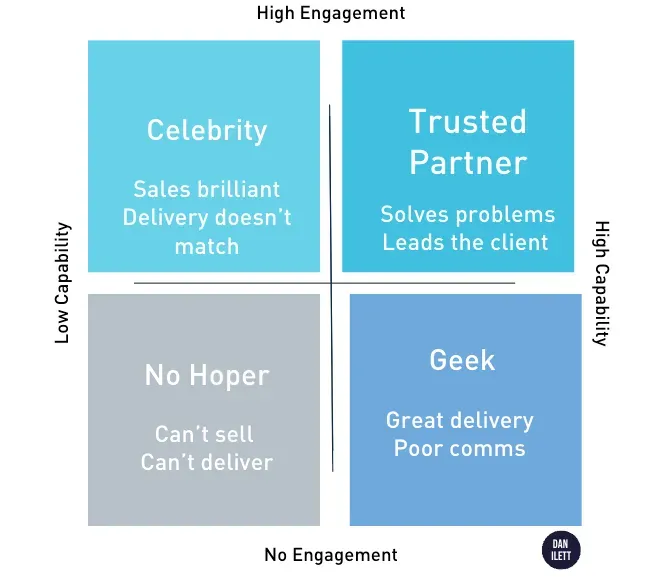
It sounds obvious, but there were many errors this fixed for this team, leading to more than a half-a-billion dollars of extra revenue for that company.
But in the last two years, after three Growth Blockers research projects with Tollejo - the growth consultancy - I realised things had changed.
In the research, sellers said being bold still works, but clients are taking longer to make decisions, they are more high maintenance and need more reassurance.
From the buyer interviews however, buyers said they feel less secure in their own decisions than they did before Covid and feel they need to ask for the support of others so they don’t do the wrong thing.
Good governance and regulation were cited, but what was clear was that independent buying decisions have become less common. Buyers want to be hand-held by sellers and their colleagues.
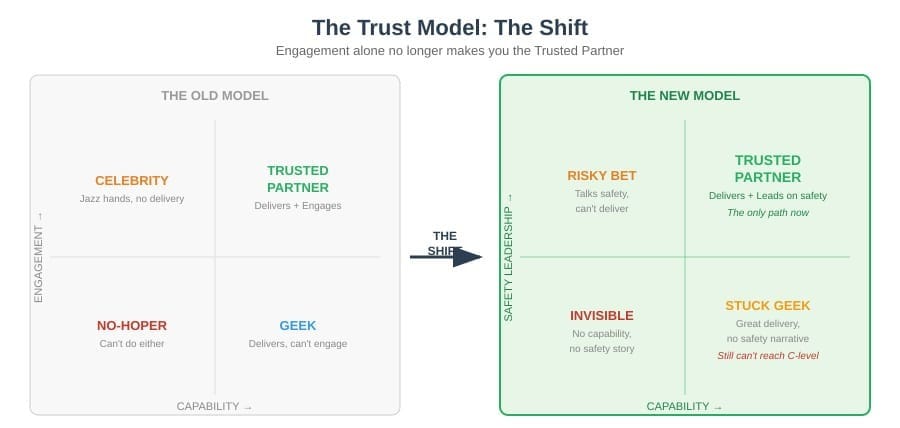
Even the CEO will now refer to others for decisions they once would have made quickly by themselves.
The Backdrop

1980s Rambo leaders don't rule the boardroom any more. But has My Little Pony taken over too much?
What is clear is that business is operating under intense pressure from every direction:
- AI disruption
- Tax policy tightening
- Geopolitical volatility
- Inflation & wage pressure
- Supply chain fragility
- Regulatory creep
- Capital constraints
- Cyber risk
- ESG scrutiny
- Workforce shortages
- Board risk-aversion
- Cost-cutting cycles
The volume and weight of operational challenges have killed growth mindset. It is now an achievement to leave the office alive.
That pressure is creating defensive cultures, defending the operations of the business rather than pushing its growth. Operational resilience is taking scalps.
The mindset that comes with that looks for safety. Buyers then look to sellers for not only value, but vastly more protection, insurance and cushioning than before.
Sellers with aggressive, transactional mindsets do not stand a chance.
Why This Is Happening: Self-Preservation
When in defensive mode, people are more afraid of losing what they have. They are trying 'not to lose' rather than 'to win'.
There is a huge difference in this mindset - but there are also other factors at play.
Information Overload

Just think about the volume of email pitches they receive. Or the powerpoint decks that begin with one statistic no one can deny.
"99% of people breathe air."
Every pitch now starts this way. No one nods any more, though.
But every time sellers stack another stat or fact on, they are pushing the buyer to feel more concerned they’ve failed at something else. The Fear, Uncertainty and Doubt approach is less powerful today as everyone is peddling it.
Every vendor claims transformation, ROI and success. The buyer cannot distinguish so they ask their colleagues or deprioritise
Let's face it - if you don't have to do something in your job and it's going to be hard, would you take it on?
No. So the ghosting period starts. The seller's chain has been yanked.
The seller, with mistimed expectations, then emails more information to try to 'nudge things along', but this makes the situation worse.
No Baseline
Buyers have only their own context as a reference point. They don't know if they're behind their competitors or ahead.
In contrast, sellers see more of the market, but sellers rarely show the buyer what they can see.
This is an underused opportunity for the seller who rarely provides the baseline or context the buyer really needs. Without a map, every journey feels risky. They don't know what "good" looks like in their situation so they freeze.
The seller who builds the baseline - who shows the buyer where they actually are - earns the right to show them where to go.
Covid Killed the Watercooler

Online and siloed ways of working mean fewer informal conversations where decisions would once have been made. How many people have Zoom pub sessions any more with work colleagues?
Before 30-minute video calls, you'd catch someone in the corridor and say "What do you think about X?" and get a steer in 30 seconds.
Now that conversation requires a meeting invite, a week's wait, a video call and an agenda with followups. Technology has slowed productivity in this regard.
The watercooler or the kitchen was where people built trust.
You'd hear "I worked with them before - they're solid" or "I went out with them for beers and they got me so wrecked, but put me in a taxi home and paid for it so they're good lads."
Now buyers have to rely on more formal references, case studies, LinkedIn recommendations - all of which feel performative and very dull.
The trust signals that used to flow freely through organisations now have to be clinically manufactured.
The implication for sellers is that you can no longer rely on word-of-mouth doing the work for you. You have to actively engineer the trust signals that used to happen organically.
That means building relationships with multiple stakeholders, not just your champion. It means creating shareable stories that travel through the organisation without you - and showing you have the training wheels for the client.
It means now more than ever, you need to get out from behind your desk to go and shake hands with people. Old school rules.
Propositions Unclear

Most propositions are still locked in seller-speak rather than framed around the challenge the buyer has.
For my career, this has been the gift that keeps on giving. Companies can't stop talking about themselves and forget to listen.
They lead with features, credentials and methodology.
“We are delighted to respond to this RFP.”
Lies. Are you really? So is everyone else, apparently.
Complicated propositions die in committee because nobody wants to stake their reputation on something they can't articulate. The buyer needs a confident story to tell the worried and cautious tribe what they need to do.
That confidence comes from coaching the buyer in the story they can give to the committee. But remember, while the committee likes to see confidence, it seeks safety, security and insurance first.
Sales influencer Jill Konrath says that buyers are overwhelmed, deals take forever and salespeople waste time while modern buyers are consensus-driven. She goes on to say that buyers need salespeople who shortcut the decision timeline by understanding the entire buying group, not just your champion.
The co-author of the Challenger sales series, Brent Adamson, goes on to say that confidence is the number one thing clients lack today - and it's the seller's job to give it to them.
Committee Culture

Now that decisions have gone to committee, it's culturally easy and excusable to kick the can down the line and take more time.
CEOs do not like this. It can risk their success, but the life-sucking nature of committees often overrules these days.
No individual feels accountable for saying yes - but everyone feels exposed if it goes wrong. The opportunity cost of delay or indecision is rarely measured.
Just look at the public sector - committees have become places where decisions go to die, wrapped in the language of due diligence and stakeholder alignment.
The committee dynamic creates a specific pathology: the lowest-confidence person in the room sets the pace. One nervous stakeholder can stall the entire decision.
In other words, if one person out of ten says no, the no often carries more weight than the other nine.
What This Means For Your Proposition

The seller then has two jobs:
Firstly to get that bold story over somehow, using magic enchanted spells and voodoo dolls - ensuring the value proposition is there.
Secondly, to change the committee's perception of the offer as unsafe by showing their process to be wrong. In other words, by showing the opportunity cost of inaction, the committee is revealed as the risky issue.
It is the latter that few give time to.
Committees do a wonderful job of eating themselves up - you just need to let that narrative play out and be there to pick up the pieces.
So the job isn't to sell harder. It's to make deciding feel safe.
The buyer still needs a clear, bold value proposition packed with gold, frankincense and myrrh. They want to hear strength and honour in your point of view.
But because they're being whacked around the head by HQ and bombarded with cold Hubspot emails every five minutes, they also want context.
Part 1: Context (The Map)
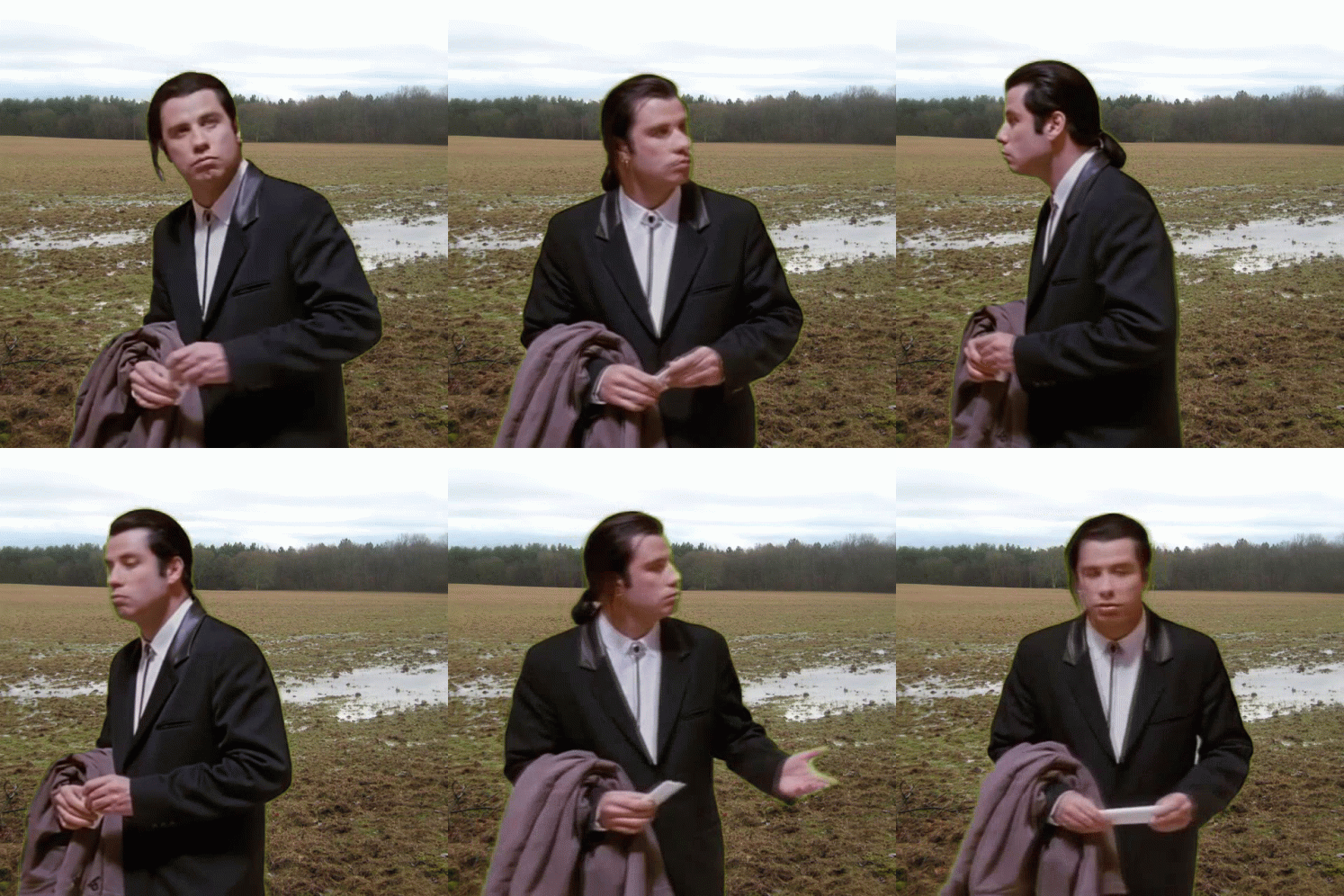
Context is the map that shows buyers where they are. Most sellers try to break paralysis by cramming the buyer's inbox with thought leadership, insight and thinly veiled invitations to irrelevant webinars.
This often backfires because the buyer has no context as to why they now need this.
The AI Example: Vendor Pitch vs Context Pitch
Many large organisations are still holding AI at arm's length. They are running pilots to nowhere because they lack context.
So another seller comes in with yet another pitch.
The Vendor Pitch: "Our AI tool increases coding speed by 40%."
The buyer thinks: I don't believe you, and I don't know if my team can handle it.
But the thinker steps back. She takes a smoke of her pipe and sips a slow coffee.
She creates a model to provide context.
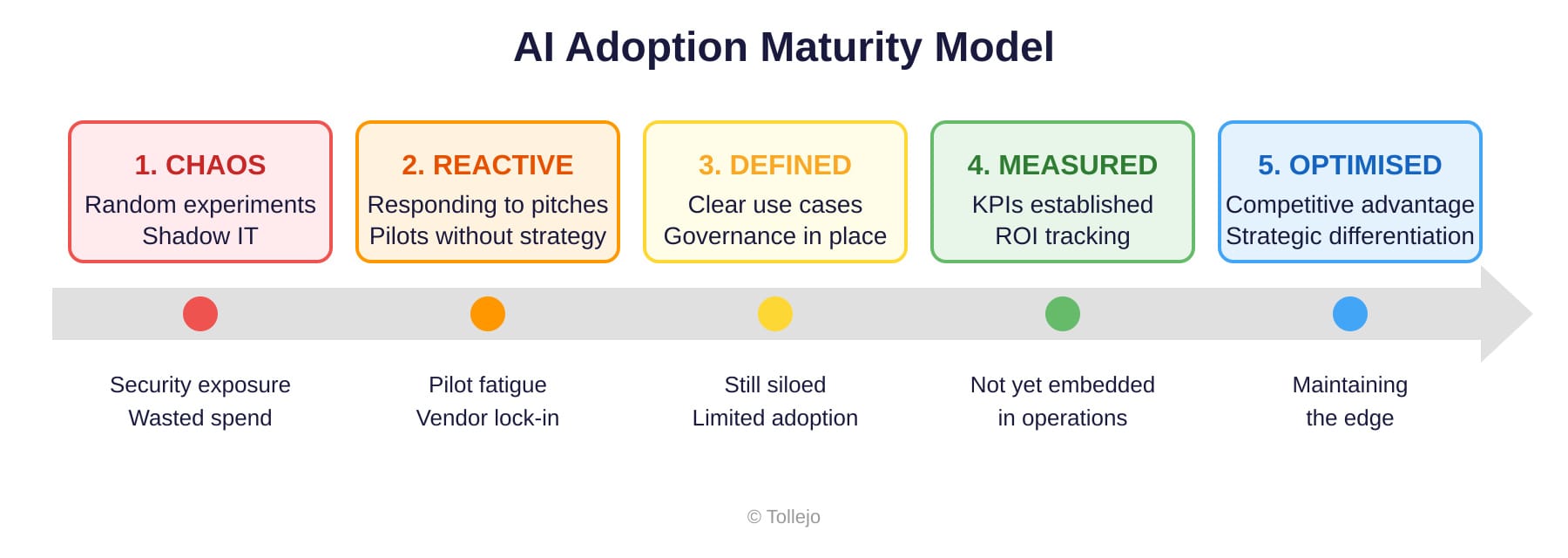
The Context Pitch: "You are currently at Stage 1 of AI Maturity and you're in the Chaos Phase.
"You have shadow IT and security exposure. Your competitors are moving to Stage 2. Here is exactly what that transition looks like - and also what happens if you let this all pile up."
Suddenly, the conversation shifts from "I don't want to buy this," to "Can I afford to stay in the Chaos Phase?"
And who keeps the company in its perpetual state? The committee.
When you place the buyer on this map, you create clarity - that alone, it's not enough to close the deal.
The Hope-to-Confidence Curve
Every deal carries two energies. The buyer's and the seller's. They do not move together, but instead like an awkward tango of mismatched partners.
The gap between them is where most deals die.

Zone of Clarity
The first meeting lands and if the pitch is good, the buyer gains clarity - and in today's context, that means the seller shows a map, a diagram or a model.
The buyer immediately understands where they are and what the landscape looks like. Their energy rises, but sellers beware at this stage of the people-pleasing comments.
"Brilliant. We so need this."
The seller sees the reaction and their energy rises faster than a teenaged boy watching Baywatch.

This is the false dawn. The buyer is interested but the seller believes they are committed.
Now if you've taken the buyer through the roadmap you created, you'd show them how to run their checks better than they do now.
In other words, you show them how to be safe when they check rather than wait for them to do it to you - badly.
Zone of Checking
Then silence, but this is normal today
The buyer's energy stays level. They are not gone, but they are checking, evaluating and running internal calculations - protecting themselves.
It is at this point the seller sees silence and their energy drops hard. They send whatever vaguely relevant toilet roll they can find in the marketing room and read the pause as rejection. They assume the deal is lost or the competitor is ahead.
The buyer is on timing of months. The seller is working in seconds.
This is where the gap opens, so if in the clarity step the seller had said: "We'll run a safety briefing for your wider stakeholders next week," the conversation would likely be open.
Your goal is to get the reassurances in before the Zone of Checking.
Zone of Reassurance
Several decades later, in your old people's home, the buyer reaches out to start asking questions.
"How would this work with our team?" "What happens if we need to pause?" "Can you talk to our CFO?"
Now is the time. These are not objections. These are signs they're past fear and into planning - and once again, being ready to show the company how to be safe rather than wait for them to work it out can accelerate the journey.
The buyer wants to know there is reversibility and shared risk. If true, the buyer's energy lifts. The seller sees movement and their energy rises to meet it.
Zone of Confidence
The two energies align, but this only happens at the end. If they get there. Clarity starts the movement, but safety completes it.
Most sellers are not set up for the above, but are set up for information and content-led processes to inspire confidence.
This fails or delays in many cases today.
Closing the Gap
The gap opens because sellers lead with "me too" content such as product features, company credentials and generic case studies.
In other words, the seller saying: "We do x" too much, means it's probably a lost deal.
The client listens politely and then spends the next weeks or months building their own agenda internally. You lose control of the narrative.
You can close the gap by leading with context, showing them how to understand their position before you talk about yours.
Show them where they sit on the maturity curve. Model the problem and draw the diagram. You might even name it.
By doing this, you put the lens on the client's agenda rather than letting them build their own. You shorten one stage entirely, but you must be ready and proactive with safety checks.
If you thought you had the mitigations covered, think again. The work you put into anticipating objections, building reversibility, sharing risk and providing internal justification tools will take you a long way - but get them out there once they understand the options and the journey - not after.
Part Two: Safety - The Vehicle
Safety is now the vehicle that gets buyers to buy.
The first thought today is often not 'how good would this be if it worked?', but instead 'what needs to be true for this to not fail?'.
To bridge the gap, you must systematically dismantle the fear.
The Decision Safety Model
Enterprise buyer safety breaks down into three layers. Each one can stall a deal, but they require different responses.
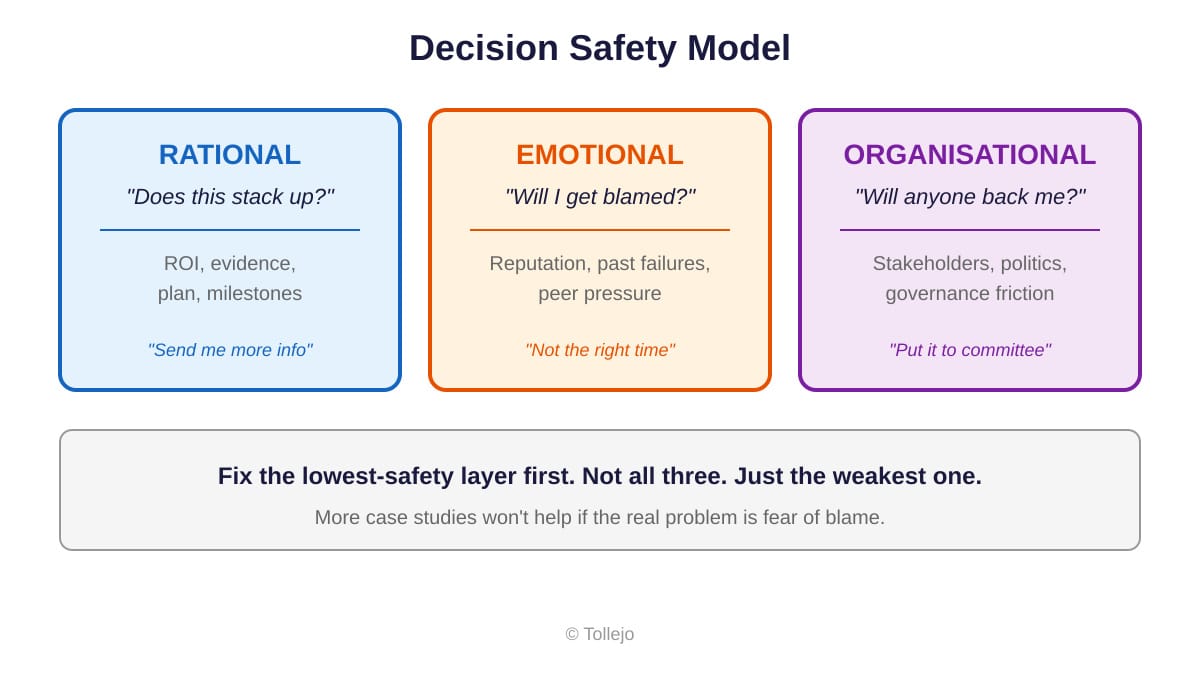
Rational Safety: "Will it cock up?"
This is the logic layer of ROI, evidence, plan and milestones. When this layer is weak, you hear: "Send me more info" or "We need to build the business case." The fix is data, proof points and clear projections.
Competitor context of wins is needed here alongside logical explanations.
Emotional Safety: "Will I get blamed?"
This is the personal layer with reputation risk, past failures or peer pressure. When this layer is weak, you hear: "Not the right time" or "We need to think about it."
The fix is not more data, but emotional and relationship strengths, showing reassurances, shared risk and proof that others have made this decision safely.
Organisational Safety: "Will anyone back me?"
This is the political layer - stakeholder alignment, internal politics or governance friction. When this layer is weak, you hear: "Put it to committee" or "We need to socialise this internally."
The strong fix here is to show the committee it is weak - without offending - and its safety is not up to scratch. Show leadership in standards here. In other words, the opportunity cost of not working with you is far worse than working with you.
Zoom Out

Now you might say - none of this is new. These are objections that we have always faced. That is true, but the intensity of uncertainty buyers portray is new.
So to get into the buyer's mind - assume they are curious but petrified of change.
Then throw the kitchen sink at showing the map: context (you are here), with what happens if you go in different directions.
The Switcheroo Sales Model
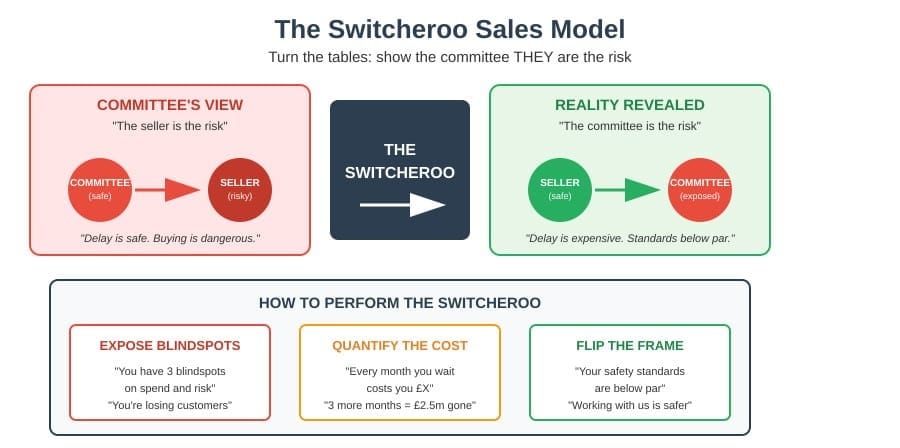
The committee default is that you're the risk. Meanwhile, every month of delay costs them money, customers and competitive position - but nobody's measuring that.
The Switcheroo is the moment you flip the frame. You stop defending yourself as safe and start showing them they're exposed. Their spend is leaking, their risk standards are below par and their competitors moved six months ago.
The seller isn't the danger - the committee is.
This lands at Barrier 6: Internal Case. By this point you've built the context, shown them the map, earned permission to challenge. Now you use it.
"You currently have three blindspots on spend and risk, which means you're losing customers.
We know you know this - but to continue this way for another three months costs you £2.5m."
You're not selling any more, but diagnosing. And the diagnosis is uncomfortable: the safe choice isn't safe at all.
Your job isn't to fight that but to let that narrative play out, quantify what it's costing them, and be there to pick up the pieces when they finally see it.
The Switcheroo works because it doesn't attack the committee - it holds up a mirror. And what they see is a group of people who thought they were being careful, but were actually being reckless.
The Ten Barriers to Safety

Stories unblock barriers. You need to tell a story that gets the client to their destination safely, ensuring they understand their context at every point.
The ten barriers listed below are the practical steps that dismantle fear. Each one addresses a specific anxiety the buyer carries but won't say out loud. They run in sequence because trust builds in layers.
You can't ask someone to share risk with you before you've proved you understand their world. You can't offer reversibility before you've shown them the journey. Skip a step and the buyer feels it, even if they can't name it.
These barriers sit across all three safety layers. Some are rational - proof, evidence, the business case. Some are emotional - the personal win, the fear of blame. The rest are organisational - internal justification, stakeholder alignment, the exit clause.
Work through them in order and you systematically remove every reason the buyer has to say "not yet" instead of "yes".
You cannot skip steps. You must address these barriers in order.
|
Barrier |
Purpose |
R |
E |
O |
|
1. Context |
Show them where they are |
● |
|
|
|
2. Position |
Where they sit vs others |
● |
● |
|
|
3. Landscape |
What worked, what failed |
● |
● |
|
|
4. Permission to
Challenge |
Earn right to reframe |
● |
|
|
|
5. Proof |
Evidence of value AND
safety |
● |
● |
|
|
6. Internal Case |
Materials for stakeholders |
● |
|
● |
|
7. Process |
Win hearts and minds |
|
● |
● |
|
8. Shared Risk |
Skin in the game |
|
● |
|
|
9. Reversibility |
Exit points if needed |
|
● |
● |
|
10. Insurances |
Guarantees and SLAs |
● |
● |
● |
R = Rational Safety | E = Emotional Safety | O = Organisational Safety
You cannot skip steps. You must address these barriers in order.
Act One: Build the Map (Barriers 1-3)
Before you talk about yourself, help them see themselves.
1. Context - Show them where they are. Build the baseline. "You're currently at Stage 2 of AI maturity. Here's what that means. Here's what Stage 3 looks like. Here's the gap."
2. Position - Using the map, show where they sit versus others. Not to scare them - to orientate them. "You're here. Your competitors are there. This is the gap you're carrying."
3. Landscape - What has worked. What hasn't. Who fell off the map and why. "Three companies tried this. Two succeeded. One didn't. Here's why."
If you skip this act, everything else is selling into a vacuum.
Act Two: Earn the Right (Barriers 4-6)
Now you've built the map, you've earned permission to challenge.
4. Permission to Challenge - Reframe their journey. Only now do you bring the value proposition: what you'll do, ROI, relationships, performance commitments. But safety, security and risk stay front and centre. "If you execute the plan you just showed me, you'll hit a wall in six months. Here's why. Here's the alternative."
5. Proof - Not just proof of value. Proof you keep companies safe. References on video. Stories of how you protected clients, not just delivered for them. "Don't take my word for it. Here's what our client says. Here's her number."
6. Internal Case (The Switcheroo) - This is the pivot. Show the committee they are unsafe. The opportunity cost of not working with you is riskier than working with you. "You have three blindspots on spend and risk. You're losing customers because of it. Three more months of this costs you £2.5m."
Most sellers never get here because they didn't do Act One.
Act Three: Close Safe (Barriers 7-10)
You've shown them the map. You've performed the Switcheroo. Now make it impossible to say no.
7. Process - Run workshops that are as slick as theatre plays. Every touchpoint reinforces safety.
8. Shared Risk - Skin in the game. If it fails, you feel it too. "If we don't hit Stage 3 KPIs by month three, you don't pay for Stage 4. We bet on our own performance."
9. Reversibility - Exit points highlighted on the map from phase 1. The ability to stop without catastrophe. "We have a 90-day review. If it's not working, we pause. You're not locked in."
10. Insurances - Guarantees and SLAs are the start, not the end. The individual needs assurances they can use when someone asks "what if it goes wrong?" Don't go standard. Go beyond. "Here's the SLA. Here's what happens if we miss it. This is your insurance policy."
Final Thought
Today value creates interest, but safety creates decisions. If you have the best product but the buyer doesn't feel safe, you will lose to "no decision."
You'll feel ghosted and wonder why. Change that way of thinking. Realise you didn't make it safe enough.
Make it safer to say yes than to do nothing. That is the work.
Tollejo: Check out the new website.
 Jen Miller
Tollejo works with CEOs to build better propositions, narratives and sales outcomes. We deliver strategic sales, marketing and communications for growth challenges, assessing performance and board dynamics.
We help companies safely transition their growth practices, stripping enormous cost from unused technologies and processes.
Our clients are in tech, professional services, financial services, government and engineering. We help them:
- Understand demand
- Use AI to be more effective in sales, marketing and growth
- Set a clear narrative for the business
- Turn that narrative into a go-to-market strategy
- Align brand, sales and communications to the customer
- Create value propositions that customers want
- Improve win rates, deal value, board dynamics and commercial performance
We are narrative specialists, commercial leaders, brand strategists, former FT journalists and data specialists. We’ve unlocked $1bn+ in client deals and have worked with IBM, Microsoft, Equinix, SEB, Virgin, Google, Cisco and Cognizant, among others.