


Being a CEO is highly stressful and sometimes you have to wonder why you took it all on. Hiring the wrong people, not hitting the number, deploying the wrong project - and having to ask 'have you done it yet' about 100 times a day.
If everything works, the team did it. If one thing goes wrong, it’s on you.
But this year, you should pay closer attention to distraction.
Distraction is your number one enemy of good decisions.
You might be thinking about next week's Davos selfie-stick, Linkedin-luvvies posting pics from the basement. The surge in geopolitical manoeuvres also has us all on edge. Or you might simply be taking in too many garbage Karen videos on Instagram.
None of this is helping you to grow the business, but the Fear of Missing Out (FOMO) is ruling a part of your brain that you need for high-quality thinking. Social media is robbing your best thinking time - and those who work for you.
The reality is you're not really missing out. You're being marketed to at a rate never before possible. The human brain isn't wired for it.
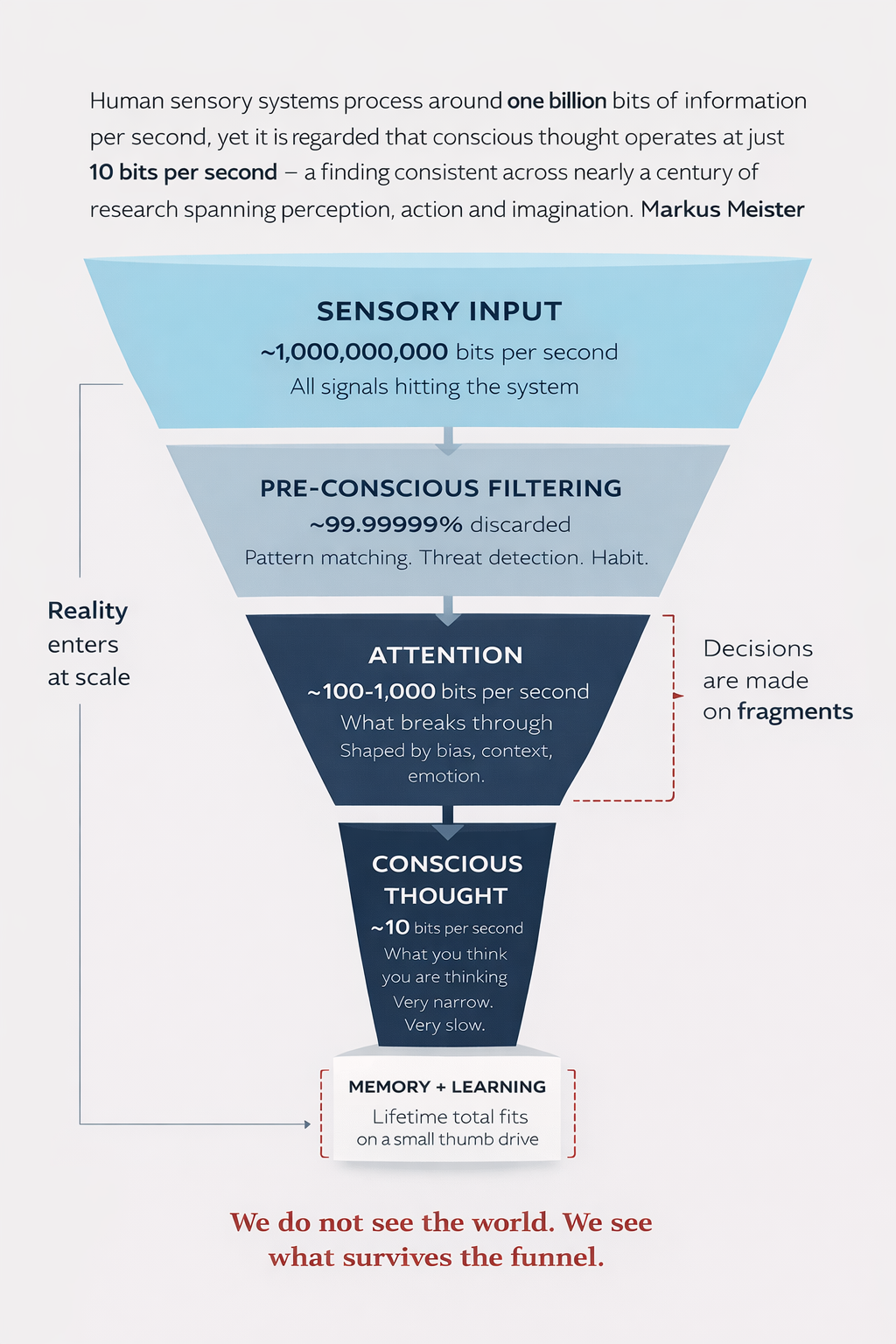
Human sensory systems process around one billion bits of information per second, yet it is regarded that conscious thought operates at just 10 bits per second - a finding consistent across nearly a century of research spanning perception, action and imagination.
According to Caltech researchers Jieyu Zheng and Markus Meister, this means human cognition functions roughly 100 million times slower than sensory intake, with the total information a person can learn across their lifetime able to fit comfortably on a small thumb drive.
Humbling, isn't it.
The more you cram into your tiny mind at Tiktok speed, the harder the brain has to work - and what is the outcome?
$650 billion. The estimated annual global cost of information overload. That's roughly the GDP of Switzerland lost to the simple fact that we can't process what's being thrown at us.
A University of Stuttgart study from 2018 suggested the cost of information overload was $650 billion, roughly the GDP of Switzerland at that time, lost to the simple fact that we can't process what's being thrown at us.
FOMO is powerful because it exploits something base. We are social animals. When everyone else seems to know something you don't, your nervous system registers threat. So you scroll, click and attend. You say yes when you mean no. You turn up when you should be building.
These distractions are expensive. What you really need is a conscious effort to improve the quality of your thoughts.
A 2020 study of 847 employees found that workplace FOMO directly predicts burnout and compulsive message-checking. But in organisations where leaders respected boundaries and didn't expect 24/7 availability, these effects were significantly reduced.
FOMO isn't just a personal failing - it's a leadership culture problem. If you want your people focused, model the discipline yourself. Your brain processes conscious thought at 10 bits per second. Every scroll is a withdrawal from a very limited account.
What you need is a conscious effort to improve the quality of your thoughts - and those around you.
Just Say 'No'
You often don’t need courses or coaches. You just need a clear mind. Sometimes a friend or an advisor can help here, but that’s for the stuff you truly can’t tackle.
In 1986 Brian Tracy, a US coach, said: "Go into the silence. Go and sit down quietly by yourself for 30 to 60 Minutes, most people in our society have never sat quietly for 30 to 60 minutes in their entire lives."
How often do you get to do that these days? You must reclaim your thinking time.
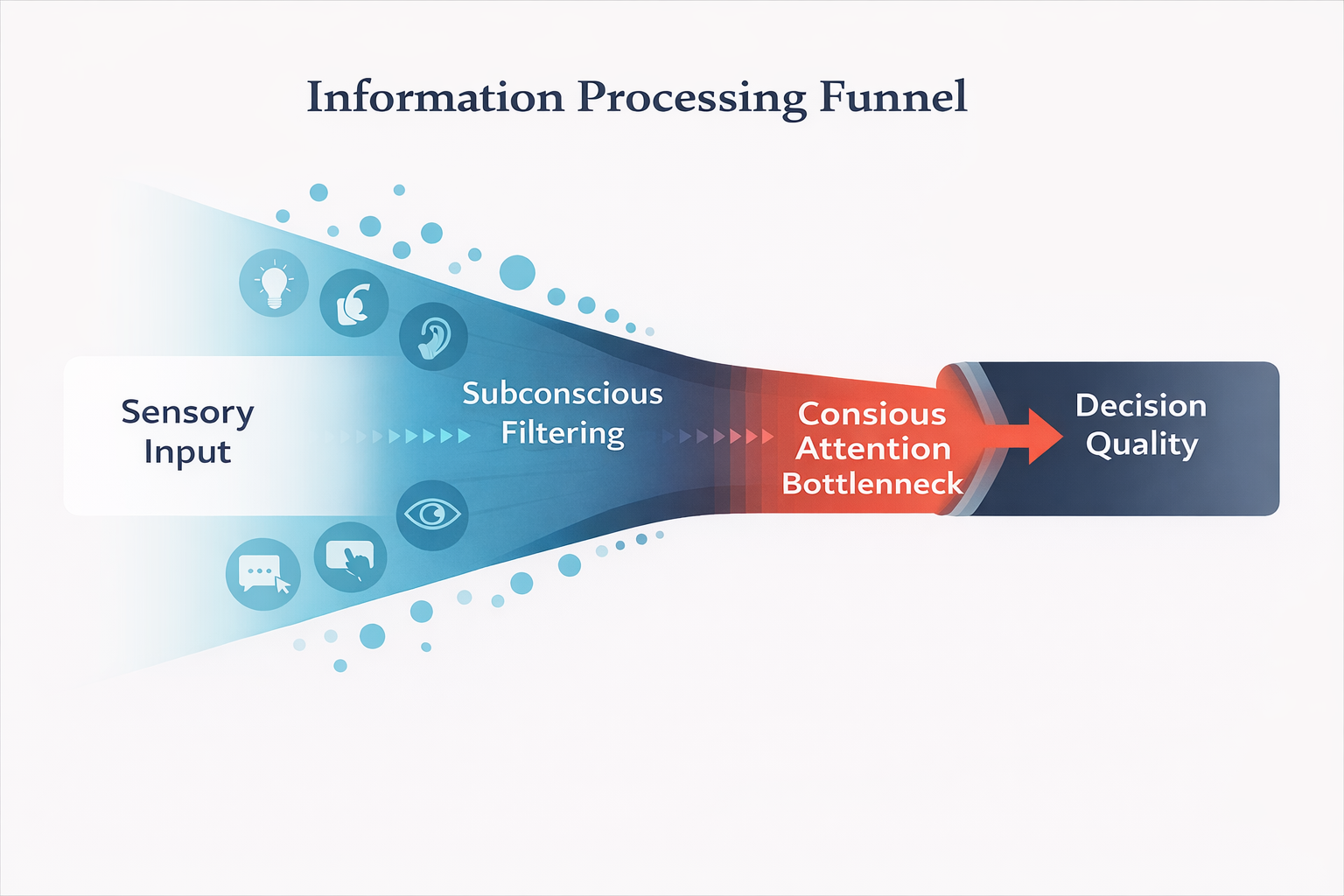
The Joy of Missing Out (JOMO) is a movement coined about a decade ago. The idea is to put the blinkers on, give yourself more time to think to regain control and clarity - and it's not woo-woo.
People with high JOMO sentiment report higher psychological wellbeing and lower social media addiction. They've reclaimed the cognitive space that constant connectivity colonised.
In other words, turn off the garbage and feel happier. Who knew.
Moses Itauma, the heavyweight boxer I interviewed last year, put it simply. He deleted Instagram not because he's anti-technology but because energy spent scrolling was energy taken from his work.
"If I spend 10% of my energy arguing with pundits it takes away from my boxing."
So this year, we're all about JOMO. The confidence to miss the noise because you're committed to the focus.
If you look at some of the best ringleaders who attract the masses, they are not falling for FOMO gimmicks. They're the ones leading it. You don't see big tech leaders letting their kids loose on social media.
Get Practical: Woo-Woo Time
Let's look at some ways to design better thinking time.
In summary, my advice is to be like a Yorkshire clockmaker: tight on your time.
Prioritise sleep, delete your social apps, read more before bed and stop freaking out about what you're missing out on or you can't control. Your focus needs to be on your next few steps and to ensure your own mojo is working. Don't worry about his.
Of all these points, I would suggest to focus on one at a time - and to give yourself a little time every day to think about the area you're focused on.
Sleep. People who sleep less than six hours for four nights in a row are as cognitively impaired as someone who can be arrested for drunk driving. A lot of CEOs lose sleep. You need sleep.
I used to go to bed when I was tired and always wake up at 5am. Gym, cold showers etc. Did it help? I liked the mental discipline, but if I didn't get up I really got negative about myself - and sometimes I would be very tired.
I naturally wake up at different times every day. So instead, I set a fixed bedtime. I like to wake early, but sometimes it's 4:30am, sometimes it's 6am. The fixed bedtime with flexible waking window removes a lot of guilt from your day and your productivity goes up.
You have to be really strict with yourself on it.
Social. Delete your social media apps on your phone. You can still check in your desktop sometimes, but this immediately removes the temptation to check stuff. It’s amazing how little you think about them.
This helps at bedtime too - and with sleep.
Books. Reading before bed is a pleasure and one I had substituted for looking at social apps. A waste of time when you can read a great book. A lot of my friends write books and frequently ask for my feedback so this was a great shift.
Among self-made millionaires, 88% read for at least 30 minutes every day. This is one of the best slow-time exercises you can feed your brain on.
Food. Yes, garbage in = garbage out, but timing matters too. A study of over 124,000 Americans found that eating within an hour of bedtime more than doubles your chance of waking in the night. You're looking to reduce the insulin spikes.
Exercise. Not the hectic stuff - just walking and lifting. A Stanford study found creative output increases by 60% when walking versus sitting - and the effect lingers even after you sit back down. Walking is one of the best ways to have a meeting.
Supplements. The three I have found to be most effective for me are magnesium for sleep 30 mins before bed, omega 3 for focus and these Zooki electrolyte pouches that make you feel very alert in the day.
Booze. Hangovers impair short-term memory, sustained attention and processing speed - exactly what you need for executive decisions. Workers rate themselves 39% less effective when hungover
I gave up alcohol a couple of years ago to deal with the lack of sleep from having a son with type 1 diabetes. That gave me better sleep, more focus and presence as a parent. I still go to pubs as I cannot do without the banter and bad-carpet culture.
I did this by giving myself windows to drink. In other words, you can't drink until you reach a window but then you can decide if you want to or not without breaking a promise to yourself. I found I didn't want to. The first window is say, a week. The second is three weeks, then two months and then five months etc. I still hold Christmas Day open as a window, but so far I have chosen not to bother.
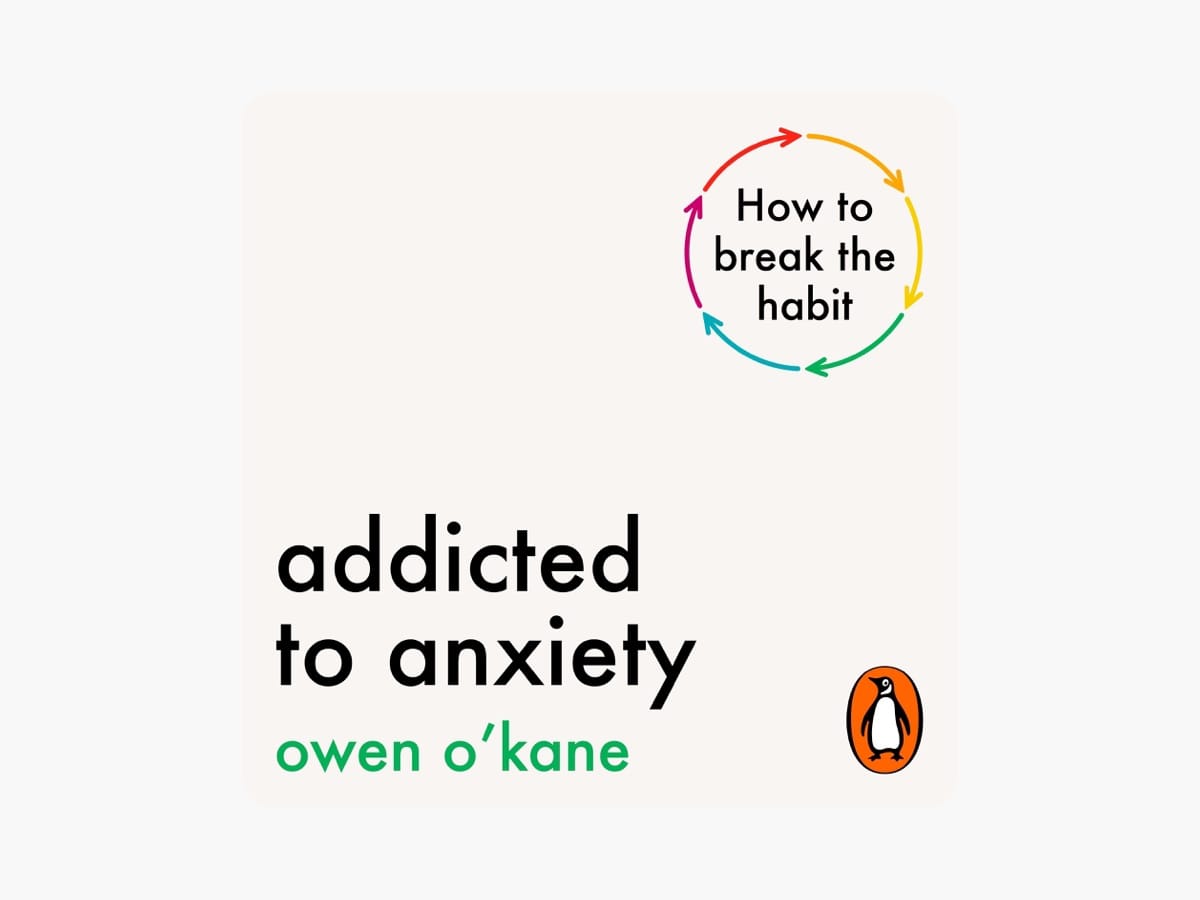
Coffee. I gave up caffeine last year because it was exacerbating anxiety. Owen O'Kane's book, Addicted to Anxiety, is also a great resource, which teaches you how to better deal with persistent anxiety. In summary, talk to it. I thought I could never survive without tea, but I now drink a ton of decaf instead.
Caffeine increases cortisol, the stress hormone, and this effect persists even in regular users. Cut it or at least stop by noon. Your baseline anxiety will drop within a week.
Write. A good rule for train journeys is either read something or write - and not emails. Apple's Journal app or similar is a very good exercise to jot down where your head is. Amazing what you notice by writing down what you think. It's a g reat way to keep an eye on guilt. It's a great source of anxiety and the perfect fuel for FOMO.
Controls around work are essential.
Help people. Your family and staff are probably suffering from FOMO too. It's within your control to free them from it. Some companies order their employees to not check emails or work messages after a certain time.
JOMO is about opting into what matters. The decision that deserves your clearest thinking and the conversation that needs your full presence.
The irony of our hyperconnected age is that presence has become the scarcest resource. Anyone can send you a message. Hardly anyone can sit with you fully there.
So be bold, shut your bloody phone off and give your brain a break. And don't forget to do it for someone else too.
Dan x
--
If you have any questions, I run an Open Office slot at Monday 2pm UK every week if you'd like to come and ask me anything.
Video call link: https://meet.google.com/ojx-tjwh-bop
--
Thanks to Giant Leap Digital and Crypto Marketing World for their support.