


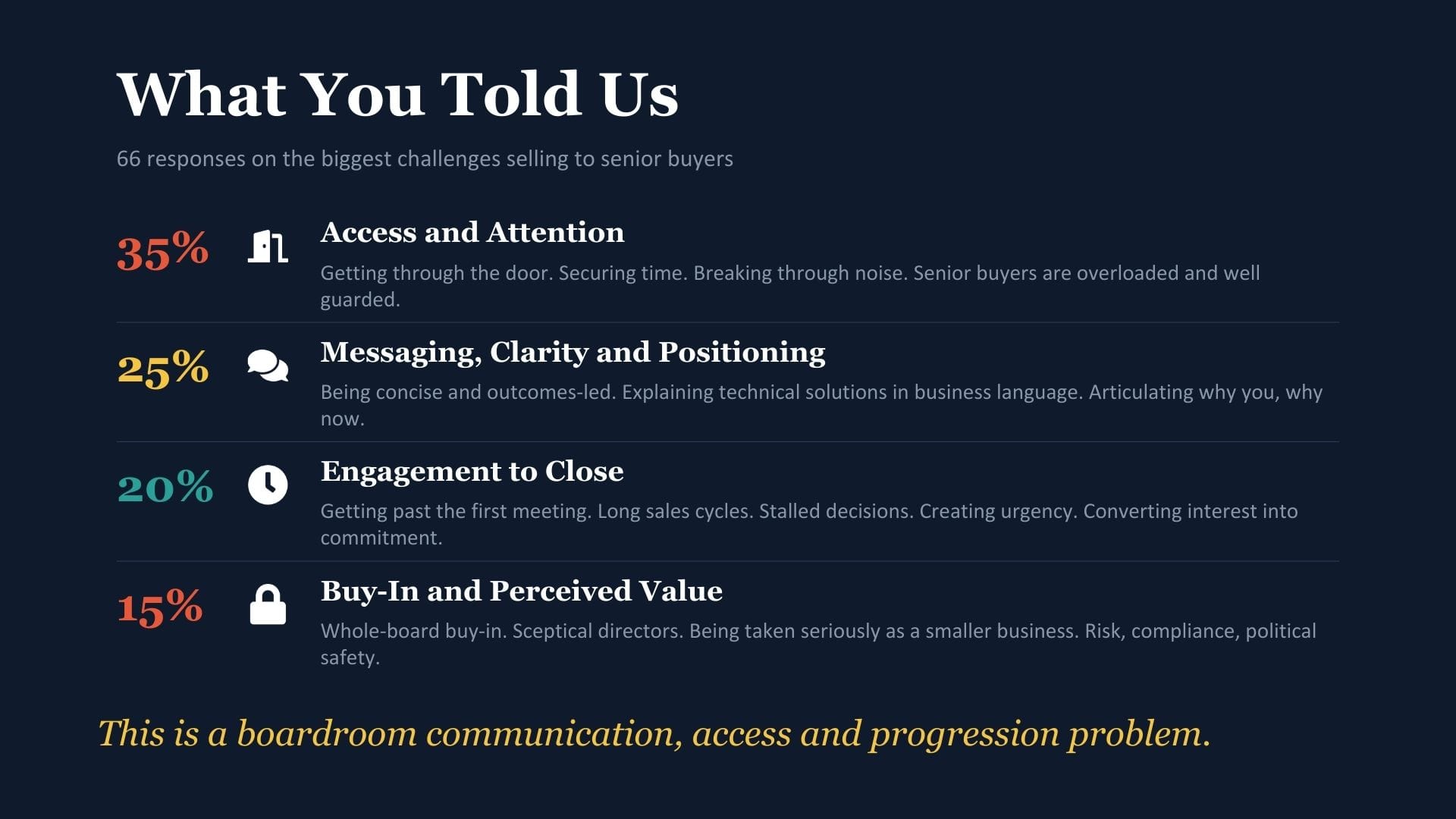
I surveyed our 66 webinar delegates on how to sell to the C-suite and asked them:
What is the single biggest challenge you face when selling to the C-suite?
The number one challenge, cited by 35% of respondents, was access and attention.
There are good reasons for this. Channels effectiveness have shifted from insights and cold emails to warm relationships, trust and faster pinpointing of problems.
As one FTSE CEO said to me last year:
We don't really know where we are. No one does. So we want context and the best way to get it is by talking to each other or using frameworks again.
Frameworks went out of fashion for a while there. The Harvard Business Review used to be full of them and now publishes more weak survey stories than Men's Health.
Now you can have all these fancy tools in your pocket, strutting into the boardroom, but if you've got any ounce of imposter syndrome lurking, it will be sniffed out and you will be burned at the stake.
A team I was working with arrived into the room to meet the CEO. The deal was worth £300 million.
On shaking the leader's hand, the CEO looked him right in the eyes and said: "I'll write the cheque now if you can tell me with absolute certainty you'll delivert it."
The team leader laughed in a very British way. He thought it was a joke.
It was not a joke.
The deal did not close.
That is what imposter syndrome actually costs you. You can prepare all you like, but if your mindset isn't there, you're toast.
I have been helping companies sell to the C-suite for fifteen years. The problems I see today are almost identical to the ones I saw at the start.
They are basic.
Companies pitch features. They send salespeople instead of experts. They fill silence with noise when the room is waiting for precision. And they wonder why nothing closes.
There are four things you need to get right.
- Mindset
- Position
- Message
- Engagement
1. Mindset
The shift required is simple to say and hard to do. Stop trying to sell something and start trying to diagnose the problem. Your job in that room is not to impress anyone. It is to understand the problem well enough to have a genuine opinion about it.
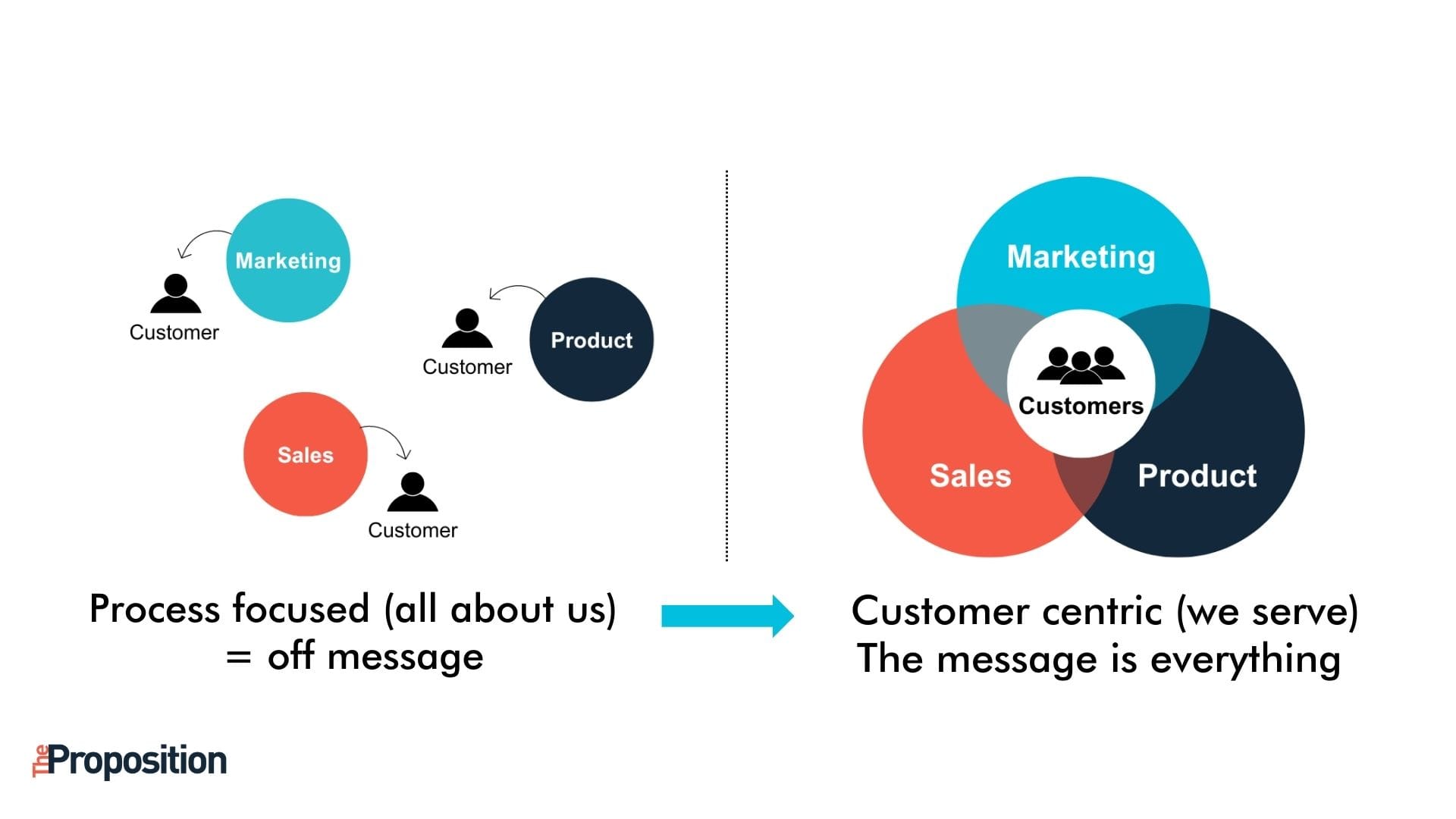
Most teams default to what we do and how we do it when the board wants to hear what changes and what it is worth.
The board does not buy how, but what changes.
Every time you walk into a senior meeting talking about your platform, your methodology or your six-phase process, you are having the wrong conversation.
The mindset shift is this: move from pushing product to providing a service.
"How can I truly help these people as human beings?" is not a bad starting point.
It forces customer centricity and customer's customer mindset.
From talking to impress to listening to diagnose. And when someone asks you to pitch, turn it back on them. Ask a question that forces them to disclose the real problem.
If you are not positioned as an expert you will not get in the room. If you are not behaving like one you will not win.
2. Positioning
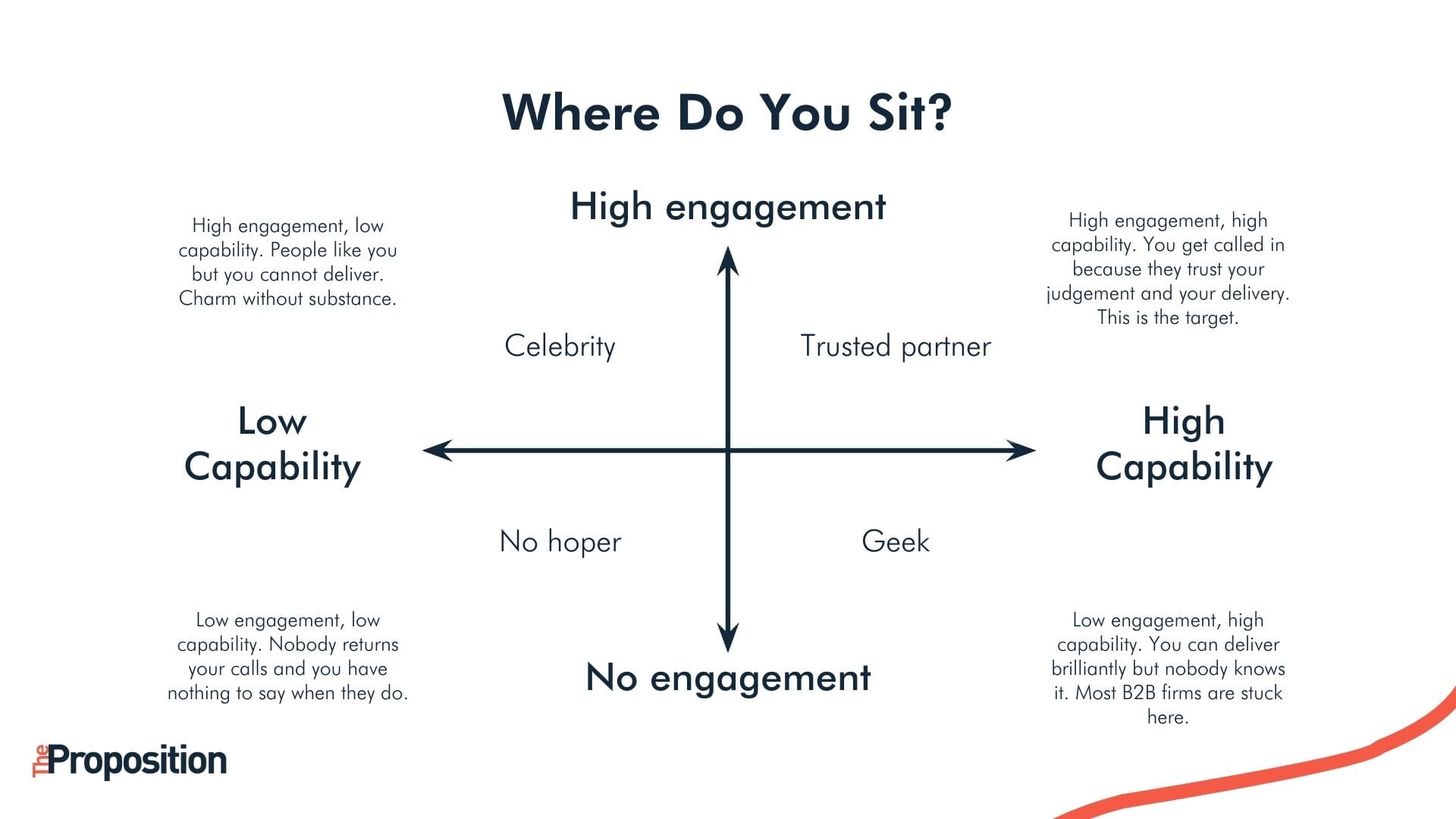
Most B2B companies are stuck in what I call the geek quadrant. High capability, low engagement. Brilliant at what they do but nobody senior knows it.
The target is the top right of this grid: trusted advisor. High capability and high engagement. The person who gets called in because their judgement is trusted, not just their delivery.
Getting there does not happen through more LinkedIn posts or a better cold email sequence. It happens through speaking, writing with real authority and being invited into organisations as a thinking partner rather than a vendor.
It takes time and it does not give you the same short-term spike as running an ad. But the effect compounds and eventually clients start finding you rather than the other way around.
The C-suite has three filters for who gets through. They need to hear about you from people they trust. They need to see evidence that you understand their world. And they need to have experienced you themselves, at an event, through something you wrote, in a conversation that had no commercial agenda attached to it.
Cold outreach to a CEO almost never works. Warm reputation almost always does.
Before you walk into any senior meeting it is worth being honest with yourself about which conversation you are actually in. There are only three reasons a B2B organisation buys anything.
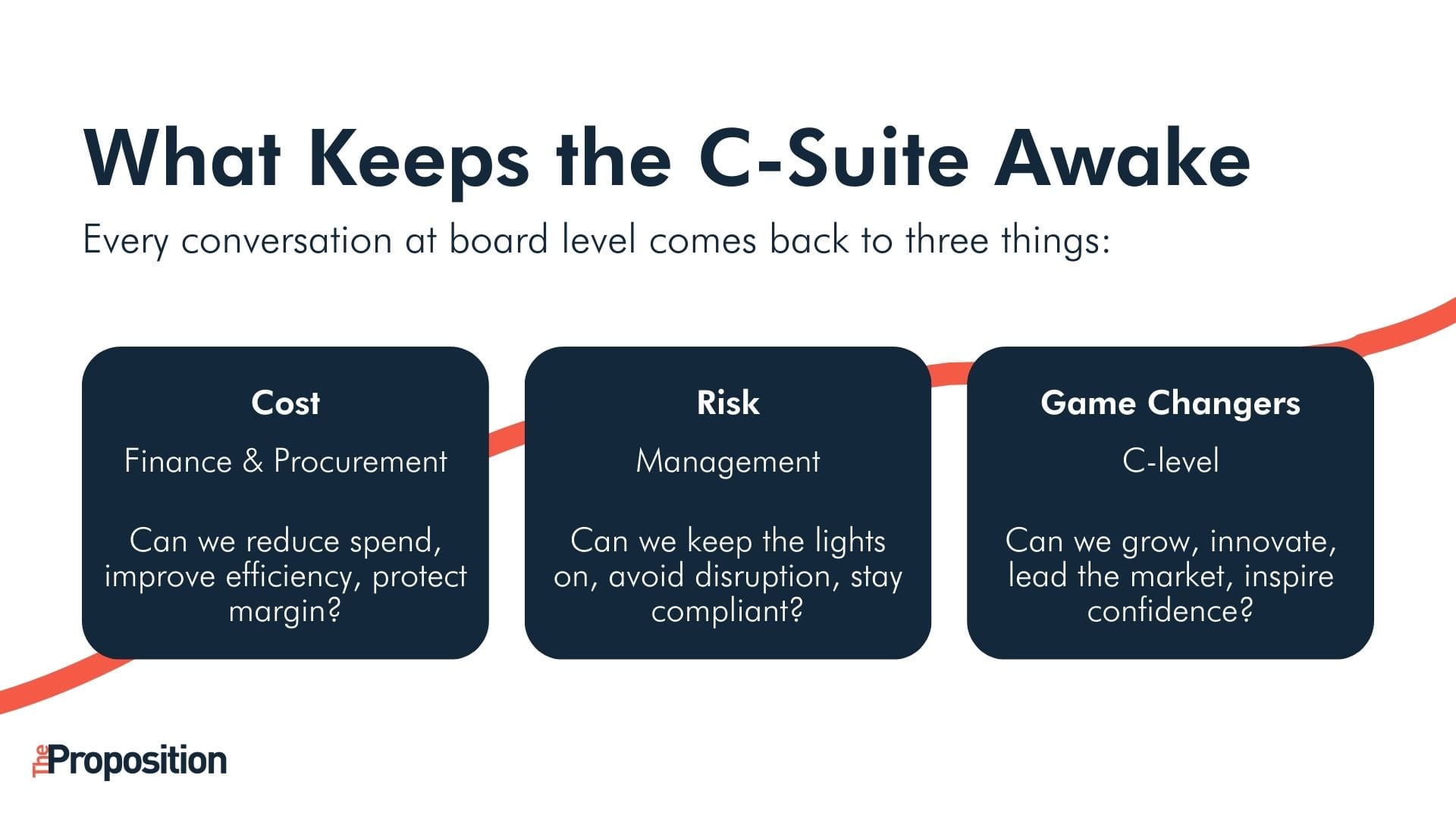
The first box here is cost. Reduce spend, protect margin. This is a procurement conversation and it is the least interesting one you can have at the top.
The second is operational risk. Keep the lights on, stay compliant, avoid disruption. Important, but it rarely gets anyone excited.
The third is game changers. Growth, innovation, killing the competition, inspiring investor confidence. This is what ends up in the annual report and this is what gets a CEO animated.
If you're not tying your business story back to Game Changers, you will get stuck in mid-management conversations.
Most companies pitch into cost when they should be speaking to game changers. Know which conversation you are in. Better still, know which one your buyer is bonused on and make sure everything you say connects to that.
3. Messaging
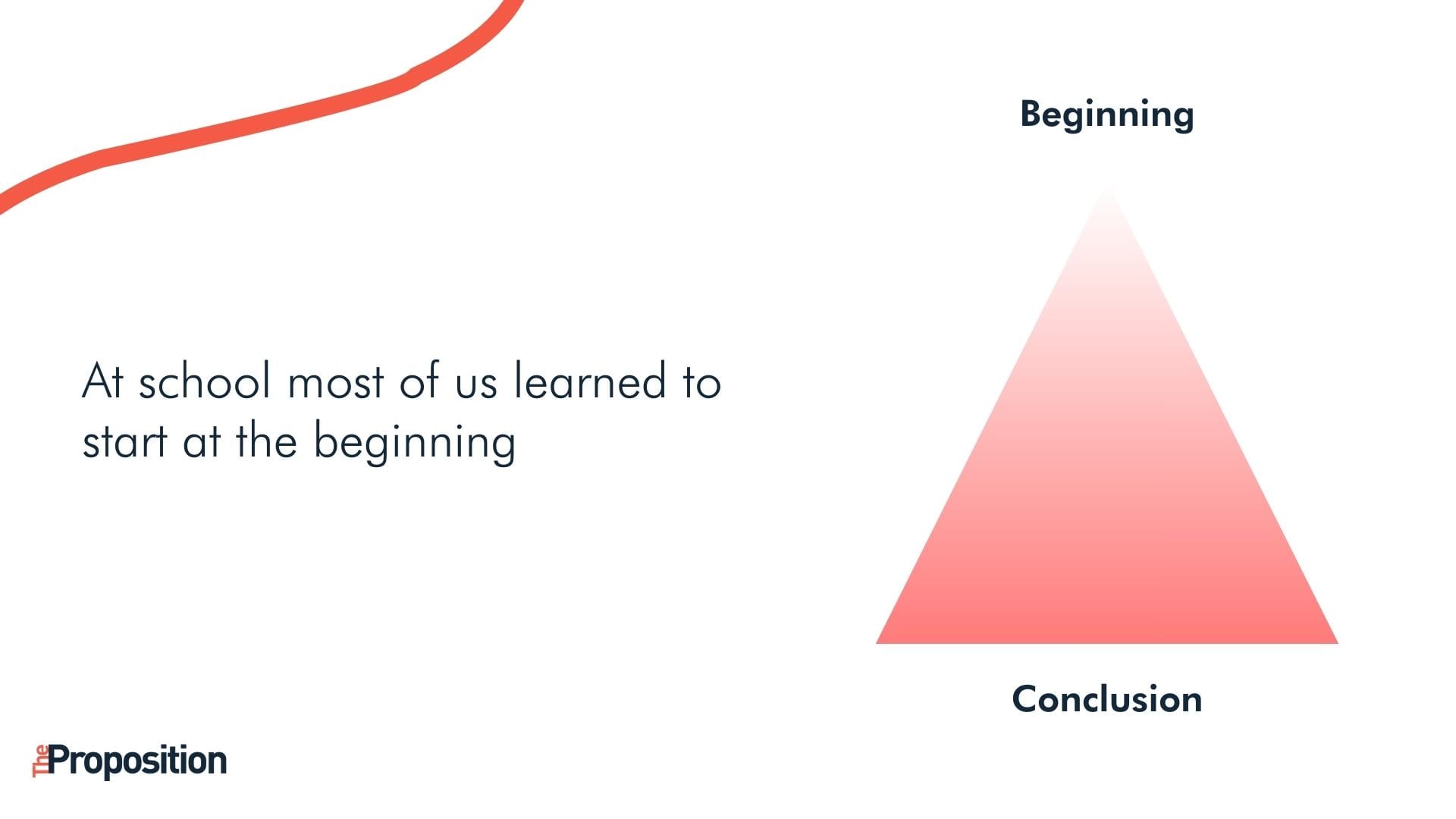
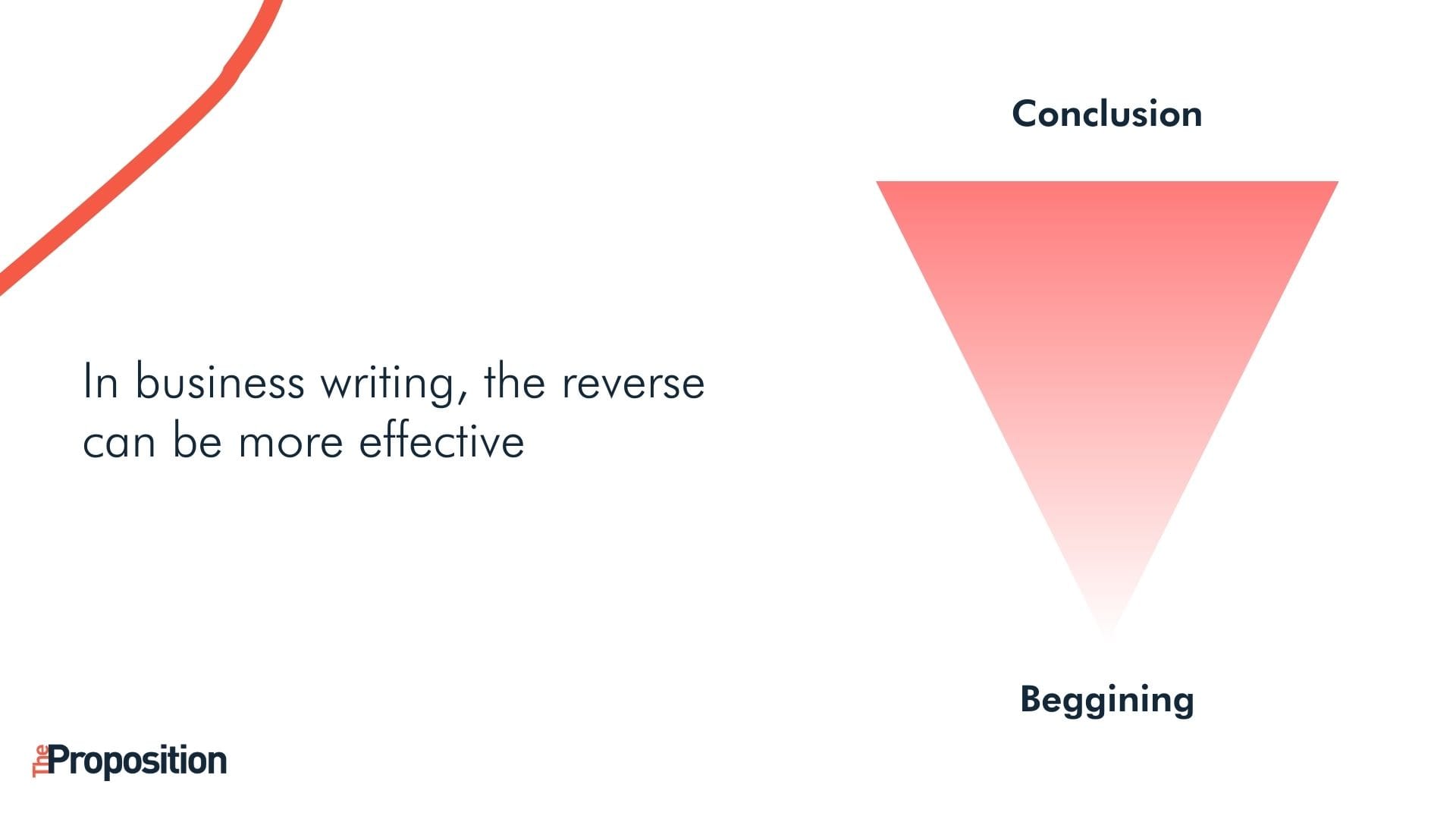
The other thing messaging requires is brevity. The C-suite is not short of information. It is short of clarity. My background is in journalism and the lesson from every newsroom I have worked in is the same: the headline has to do everything.
Lead with the conclusion. Put the most important thing first. If your emails, your proposals and your presentations are still building slowly toward a point, you are losing your audience before you get there.
4. Engagement
This is where it all comes together and where most people undo the work they have done in the previous three areas.
If you came to the webinar, you'll have heard me talk about what is working to get people in the door. But it's not happening quickly.
When you get there, you need to follow the following mantra:
Listen (80%), create (10%) and engage (10%).
Eighty percent of your time in a senior meeting should be spent listening. Ten percent creating with them, exploring what good could look like, letting them run with an idea.
Ten percent engaging and challenging, offering your point of view and demonstrating that you have a perspective worth taking seriously.
The moment you ask a senior executive what their biggest challenge is and then stay quiet long enough to hear the real answer, something shifts.
They stop treating you like a vendor. What they tell you amounts to a brief. They write the scope for you. You just have to be patient and confident enough to let it happen.
And when the deal goes into governance and starts to slow down, which it will, your job is to arm your internal champion with the story they need to fight the battle without you in the room.
The question in every governance meeting is not is this good. It is what happens to me if this goes wrong. Your messaging needs to answer that question from day one, not when the deal is already stalling.
Flip the frame: the risk of doing nothing is higher than the risk of moving forward. Get that argument in early and keep it there.
The close, when it comes, should feel like the client's idea. What does good look like for you? What would need to be true for this to work?
"Just send me a proposal" could be a fob off. Switch it around quickly to "what does good look like for you?" or "if you could have anything, what would it be?".
Basically, make them do the work as they're expecting off the peg tailoring.
You need orders as well as ideas.
Ask the question and stop talking. More often than not they will describe almost exactly what you were going to propose. That is where you want to be.
The bar in B2B is low.
It does not take much to stand out.
But it does take something, and that something starts with being willing to stop selling - get your mindset right. Invest in a position that will do the hard work for you.
Create a message your gran can understand - and when you get in the door, be the expert at diagnosing rather than speaking.
You will be kicked out and sent away if not.
Have a good day
Dan x