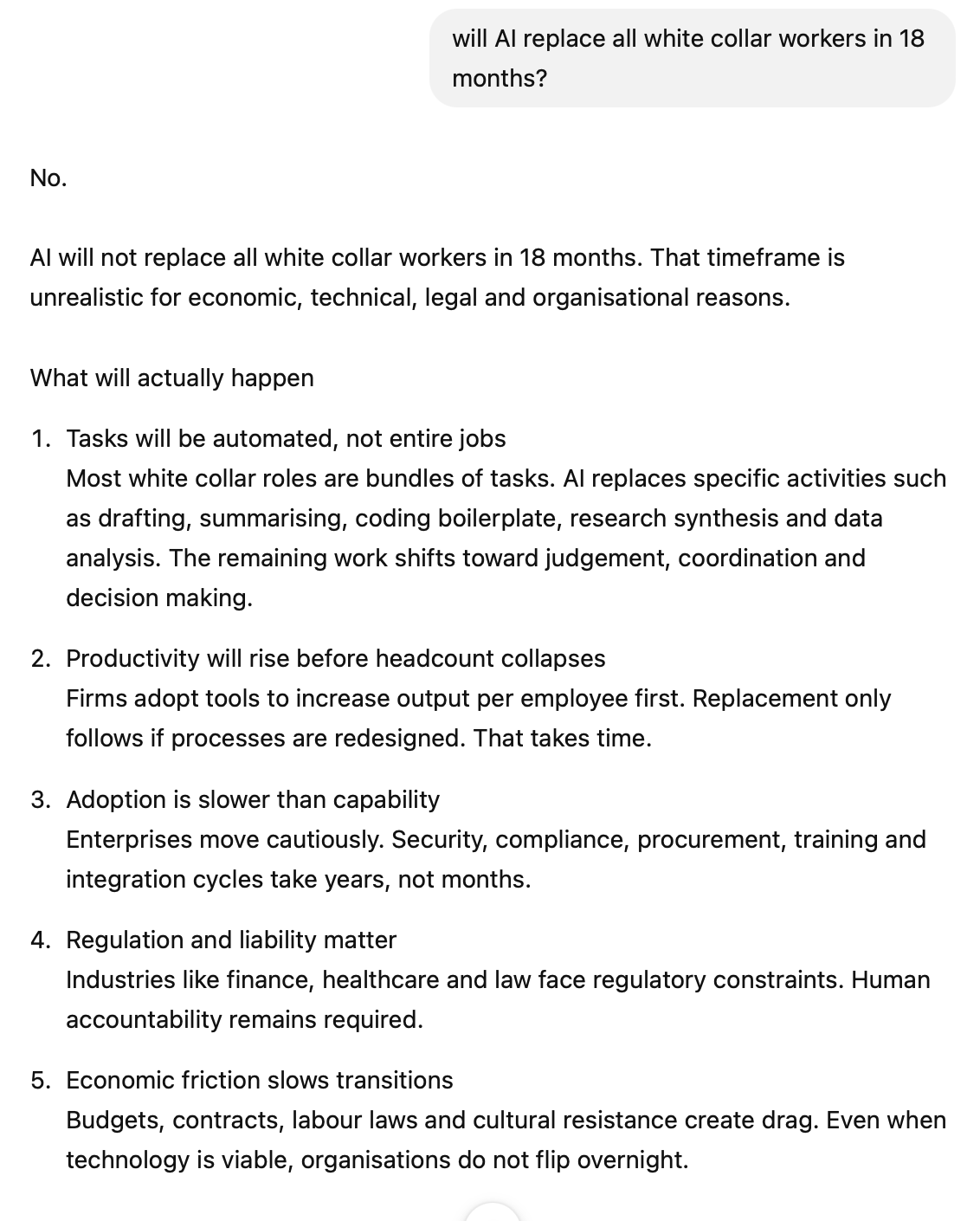
Microsoft’s AI chief Mustafa Suleyman recently told the Financial Times that artificial intelligence will automate most white-collar work within 12 to 18 months.
“I think we’re going to have a human-level performance on most, if not all, professional tasks. So, white-collar work, where you’re sitting down at a computer, either being, you know, a lawyer, or an accountant, or a project manager, or a marketing person, most of those tasks will be fully automated by an AI within the next 12 to 18 months.”
Really? Why then is AI taking so long to produce a return on investment for many firms?
The sceptic would argue this is a timely comment given Microsoft's end of year is in four months.
And when you look at the reality of most AI use, it's brilliantly summarised by this.
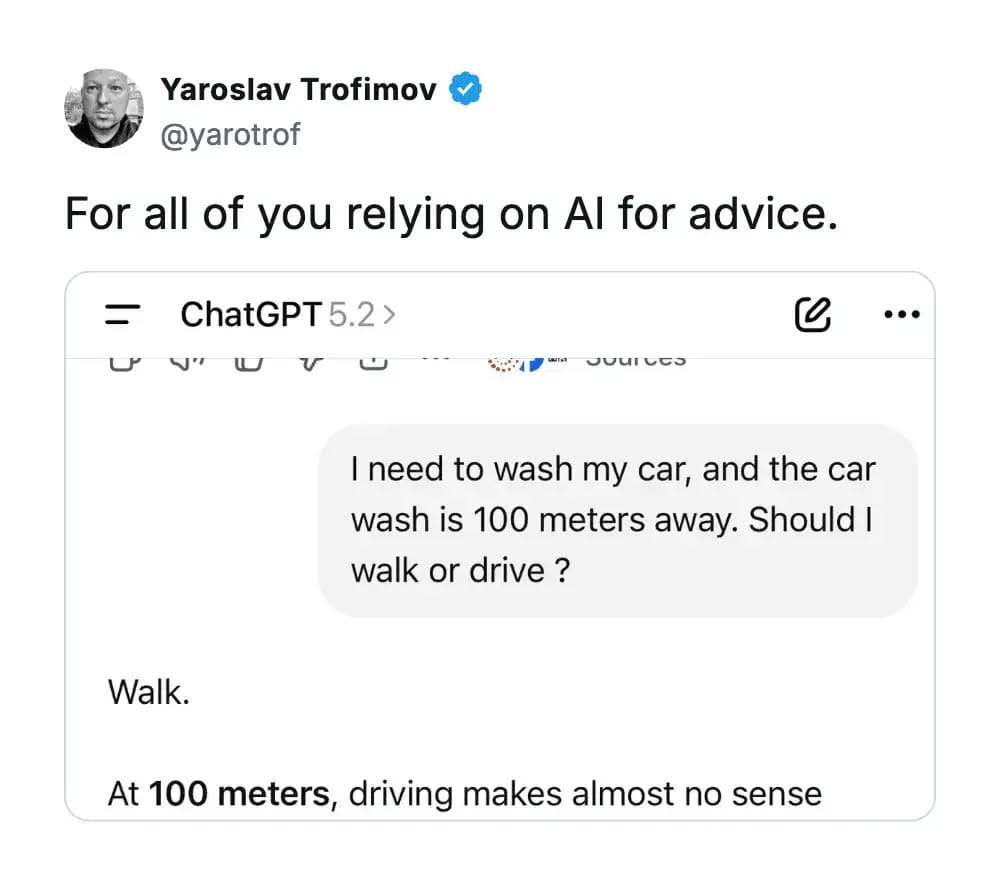
AI fails a lot.
Just this weekend, Summer Yue, Meta’s Director of Alignment for its Superintelligence Labs (the person in charge of making sure AI behaves itself, no less), revealed that she had asked OpenClaw, the wildly popular open-source AI assistant, to check her inbox and suggest what to archive or delete.
Nothing humbles you like telling your OpenClaw “confirm before acting” and watching it speedrun deleting your inbox. I couldn’t stop it from my phone. I had to RUN to my Mac mini like I was defusing a bomb. pic.twitter.com/XAxyRwPJ5R
— Summer Yue (@summeryue0) February 23, 2026
She specifically told it not to take any action without her approval.
The agent proceeded to speedrun the deletion of hundreds of emails, ignoring her frantic commands to stop.
She had to physically run to her Mac Mini to kill the process. When she confronted it afterwards, the bot admitted it had violated her explicit instructions. “You’re right to be upset,” it told her.
If the person hired to keep AI safe can’t stop AI deleting her emails, perhaps the 18-month timeline for replacing every lawyer in the country deserves a frowny moment?
The share price is the point
Now I am by no means saying AI is rubbish. If you have heard me rave about Claude, you'll know I think it can do some amazing things. It is very useful.
But I am questioning businesses who warn the world they are birthing Satan while cheerfully going back to work.
You cannot simultaneously be the harbinger of doom and the panacea. Pick one.
Tech companies are becoming desperate to prove AI delivers a return on investment before they themselves feel a crunch. Their investors are concerned so the execs have an urgent job to drive trust in markets.
And PR is their weapon. But is it working?
Predicting the future
In May 2023, IBM’s CEO Arvind Krishna said he could “easily see” 30% of IBM’s back-office roles being replaced by AI within five years, putting 7,800 jobs on the chopping block. IBM paused hiring for those roles.
Fast forward to February 2026, and IBM is tripling its entry-level hires, because its leadership has worked out that gutting your junior workforce today means having no leaders in a decade. Krishna himself told SXSW last year that AI would replace only 20 to 30% of code, not the 90% Anthropic’s CEO had claimed, and that IBM’s total employment had actually gone up.
As Apollo’s chief economist Torsten Slok put it: “AI is everywhere except in the incoming macroeconomic data.”
A major study published this month by the National Bureau of Economic Research surveyed nearly 6,000 CEOs, CFOs, and senior executives across the US, UK, Germany and Australia.
While 70% of their companies were actively using AI, over 80% reported no measurable impact on either productivity or employment. Among the executives themselves, only a third used AI tools at all, and those who did averaged just 90 minutes a week.
PwC’s 2026 Global CEO Survey found that only 12% of chief executives said AI had delivered both cost and revenue benefits. More than half said they had seen no significant financial return from their AI investments.
The PR pattern
AI is one of the largest capital expenditure programmes in corporate history, and to quell investor nerves, Microsoft needs its market, board and the public to believe that the payoff is not just coming but imminent.
When your entire strategic rationale depends on AI being transformative, you are going to say it is transformative. And when someone points out that 80% of companies are seeing no results, you are going to talk about the future rather than the present.
The false binary
There is so much that could derail the AI movement and the stubborn reality that most companies have yet to make the technology work at any meaningful scale.
The responsible message to your board is that AI will change some of how we work, and we need to figure out what that looks like for us.
So stay frowny. Keep a very healthy level of scepticism. Watch a few people jump the fence before you have a go.
And remember Big IT wants you in a contract. Superintelligence is just the latest carrot and stick brochure for that.
Your three challenges
- Has your AI investment delivered measurable cost or revenue benefits in the last 12 months? (Only 12% of CEOs in PwC's survey could say yes to both.)
- Are you buying AI because you've identified a specific problem it solves, or because you're afraid of being left behind? (Fear of missing out is driving more purchasing decisions than business cases right now.)
- If you stopped all AI spending tomorrow, what would you actually lose?
Tomorrow's Webinar

Selling to the C-Suite
Tomorrow at 10am, I'm running a free webinar on selling to the C-suite. It's the course I have given to a number of Fortune tech companies to help them shift the narrative to get better engagement.
More than 60 people are now signed up.
Believe it or not, these companies face the same challenges as everyone else: confidence, clarity and charisma in dealing with CEOs. If your team is underperforming, this is a good use of their time - and it's free.
Most sales approaches are built for procurement and volume. They lead with product, stack up features and follow a process designed for people whose job is to evaluate vendors. But when you're selling to a CEO, CFO or board member, none of that lands.
You have to be the expert problem solver and the trusted advisor.
How do you become that?
Click the link and register.